Case Study / Interaction Design · Conversational UX

UX Design UXUK Award 2018 Valtech EasyJet Holidays

EasyJet Holidays
Discovery

A preference-led holiday discovery experience built before AI existed to do it — still live on easyjet.com today, nearly nine years after we designed and built it. UXUK Award winner 2018.

Client
EasyJet Holidays
Agency
Valtech
Year
2017
Award
UXUK 2018
Role
Lead UX Consultant
Status
● Still live
```
🏆
UXUK Award Winner 2018
Best Leisure & Entertainment Experience — recognised for innovation in personalised discovery UX

The Context

EasyJet was a flight company
becoming a holiday brand.

In 2017, EasyJet Holidays was making a significant push to establish itself as a credible holiday brand — not just a flight booking service with a hotel bolt-on. The challenge was fundamental: EasyJet's customers knew how to search for flights. They had no established behaviour around searching for holidays.

Flights are searched with precision — specific dates, specific routes. Holidays are discovered with ambiguity — a vague sense of wanting sun, or culture, or adventure, without necessarily knowing where or when. The existing search-and-filter paradigm wasn't designed for this kind of open-ended exploration.

The old model
Search by destination, filter by price and date. Works perfectly for flights. Creates paralysis for holiday decisions where the destination itself is undecided.
The opportunity
Guide customers through their own preferences to surface holidays they'd love — turning uncertainty from a barrier into the starting point of the experience.

The Insight

People don't know what holiday they want. They know how they want to feel. Design for the feeling, and the destination follows.

— Insight from customer research that shaped the experience

The insight that unlocked the design was simple but significant: holiday choice is primarily emotional, not rational. Customers weren't starting with "I want to go to Malaga" — they were starting with "I need a break," "I want adventure," or "I want somewhere the kids will love."

This meant the discovery experience needed to work backwards from feeling — using progressive questions to narrow from emotional intent to concrete preferences to specific destination recommendations. It was, in effect, a conversation. Just one designed before conversational UI existed as a concept.

The Design

A conversation in
seven questions.

The discovery experience was structured as a dynamic, progressive question flow — each answer informed what came next, narrowing the possibility space without ever feeling like a filter. The experience felt like talking to a knowledgeable friend, not filling in a form.

1
Who's travelling?
The first question established the fundamental context — solo, couple, family, friends. This single answer shaped everything that followed, from the type of hotels surfaced to the activities suggested.
"Just the two of us" unlocked romantic city breaks and adult-only resorts. "Family with young children" unlocked all-inclusive beach destinations and kids' club facilities.
2
What kind of holiday?
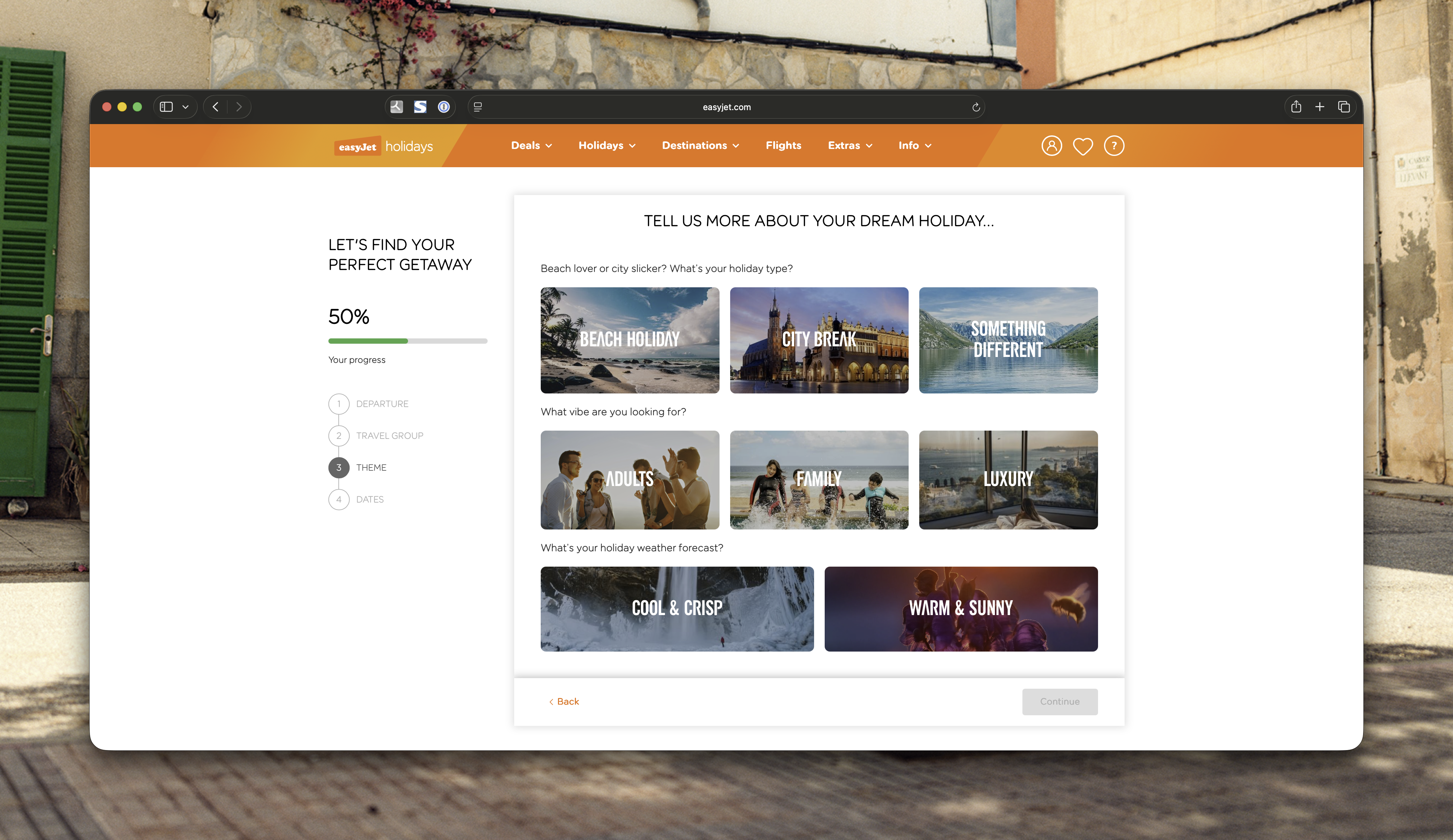
High-level holiday type — beach, city, adventure, cultural. Presented as evocative visual choices rather than a dropdown, making the selection feel aspirational rather than administrative.
3
What matters most to you?
A prioritisation question — nightlife, relaxation, culture, food, sport, nature. Customers could select multiple options, and the weighting of their choices influenced the algorithm behind the recommendations.
4
What's your hotel style?
Hotel preferences surfaced through visual cues — boutique and design-led, family-friendly and spacious, all-inclusive and resort-style, budget and location-focused. Again presented as aspirational imagery rather than a category list.
5
How long are you thinking?
Duration — a week, two weeks, a long weekend, flexible. Short-break responses opened up a different destination set than longer holidays, without the customer needing to understand the logic.
6
When are you thinking of going?
Flexible date input — rough month, school holidays, as soon as possible. Intentionally later in the flow, so destination recommendations were shaped by preferences before being filtered by availability.
7
Your personalised recommendations
A curated set of destination and package recommendations — presented with the specific reasons why each matched their answers. Not just "here are holidays" but "here's why this is right for you."
"Based on your love of food and culture, and travelling as a couple — Barcelona in October, staying at a boutique hotel in the Gothic Quarter."

Why it mattered

Conversational UX before
chatbots existed.

In 2017, there were no AI holiday recommendation engines. ChatGPT was five years away. The conversational discovery pattern we designed was solving — through careful interaction design and progressive disclosure — exactly the same problem that AI assistants solve today through natural language.

The constraint was the insight. Without access to AI, we had to design the conversation manually — thinking carefully about question sequence, answer framing, and how each response should influence what came next. That rigour produced an experience that felt genuinely intelligent, not because it was, but because the design was doing the work.

Looking at it now, it was an early example of what the industry now calls preference-led or intent-based discovery. We were building it with HTML, JavaScript, and careful UX thinking.

Outcomes

What it achieved.

🏆
UXUK Award — Best Leisure & Entertainment Experience
Recognised by the UX industry's most prestigious UK awards for innovation in consumer experience design — competing across the full leisure and entertainment sector.
💬
Pioneered conversational discovery
Demonstrated that preference-led, personalised discovery was achievable without AI — through rigorous interaction design and thoughtful question architecture.
✈️
Supported EasyJet's brand repositioning
The discovery experience helped EasyJet Holidays establish itself as a credible holiday brand — not just a cheap flights site — at a critical point in the company's strategy.
🔮
A pattern that predicted the future
The question-led discovery model we designed in 2017 is now the dominant paradigm for AI-powered recommendation engines. The problem hasn't changed — just the technology used to solve it.

Still live today

Not archived. Not rebuilt.
Still there.

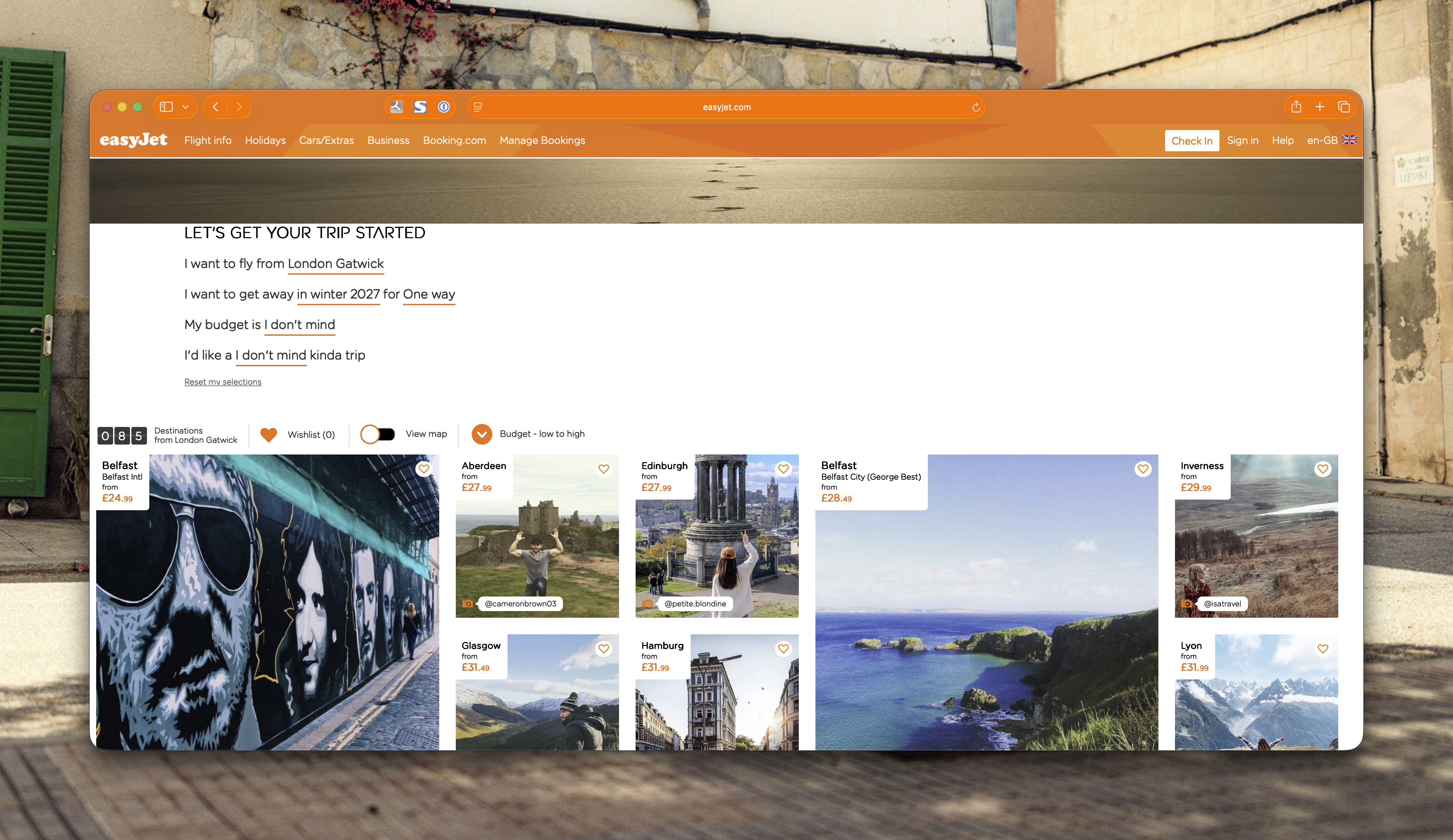
The experience we designed and built in 2017 didn't just win an award and get archived. It didn't get rebuilt two years later. It’s still live on easyjet.com right now — the original Inspire Me tool, with the same question architecture, the same interaction model, and the same copy we wrote at Valtech nearly nine years ago.

EasyJet has since built a second discovery tool — the Holiday Inspiration Quiz — but they kept the original too. Both are live simultaneously. That’s not a company that forgot to retire something. That’s a company that looked at what we built and decided it was still good enough to keep serving customers in 2026.

Live now
easyjet.com/en/inspireme · Original · Live since 2017
📸
Screenshot of the original Inspire Me tool — live at easyjet.com/en/inspireme
Add desktop screenshot when back from holiday
“Not inspired by the work. Not evolved from the work. The actual work — still live, still serving customers, nearly nine years later.”

The original Inspire Me tool we designed and built at Valtech in 2017 is still live at easyjet.com/en/inspireme today. The interface, the question architecture, the copy — “I want to... fly from... leave on... stick to a budget... choose my travel style...” — is our work. Unchanged in its fundamental design. It has been serving EasyJet customers continuously for nearly nine years, across hundreds of millions of sessions, on one of Europe’s most visited travel websites.

This kind of longevity is exceptionally rare in digital product design. Most experiences are rebuilt within two or three years. The fact that this one hasn’t been replaced — only supplemented by the newer Holiday Inspiration Quiz — is the strongest possible proof that the underlying design thinking was right.

View the original live experience ↗

Reflection

What constraints
teach you.

This project taught me something I've carried through every piece of work since: constraints force clarity. Without AI to do the heavy lifting, we had to think deeply about what questions actually matter, in what order, and why. That thinking produced a better experience than many AI-powered recommendation systems I've seen since.

The award was gratifying, but the more lasting value was the methodology it established — understanding that discovery experiences should start with emotional intent, not categorical filters. That insight applies equally to an EasyJet holiday, a Netflix recommendation, or an energy tariff comparison.

I'm also struck, looking back, by how directly it maps to what I now do with AI agents. In both cases the core design challenge is the same: how do you structure a conversation so that by the end of it, the system knows enough to give you something genuinely useful?

```

Back to the beginning

Barclays Group
Design System

100+ components. One language. Still live today.

Read the case study →
← Back to all work